Mechanics Module
Atomic stress/stress, Young's modulus, shear modulus, Poisson's ratio

Nanodcal is a quantum transport software based on first principles, with its core being non-equilibrium Green's Function-density functional theory (NEGF-DFT). It is mainly used for nonlinear and non-equilibrium quantum transport processes in analog device materials. It is possible to predict numerous electronic transport properties of materials, such as current-voltage characteristics, electron transmission spectra, and conductance, without relying on any phenomenological parameters.
Atomic stress/stress, Young's modulus, shear modulus, Poisson's ratio

Thermoelectric merit, electronic thermal conductivity, lattice thermal conductivity, Seebeck coefficient

Dielectric constant, refractive index, extinction coefficient, absorption coefficient, magnetic susceptibility (Optical)

The mobility of electrons and holes, the mean free path of electrons (MobCal)

Phonon energy band, phonon omnipotent band, phonon density of states, phonon transport channel, dynamic matrix

Spin-orbit coupling, multi-port systems, Angle systems, DFT+U/C, etc
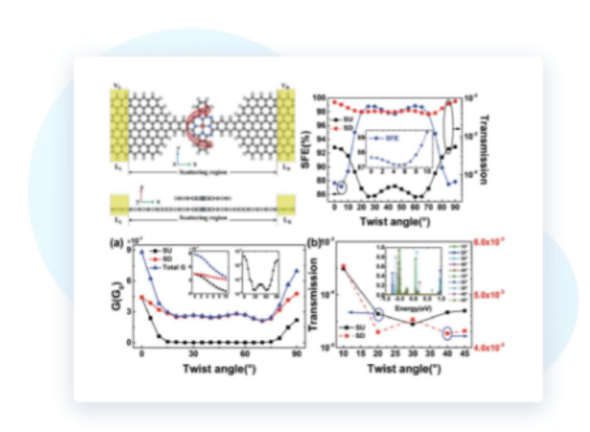
Bimolecular devices were designed using swtooth graphene nanoribbons and copper phthalocyanine (CuPc), mainly clarifying the reasons for the strange transport phenomenon induced by the torsion Angle, which is helpful for predicting the behavior of bimolecular systems at the torsion Angle.
ref. Nanoscale Advances, 3(12), 3497-3501 (2021)
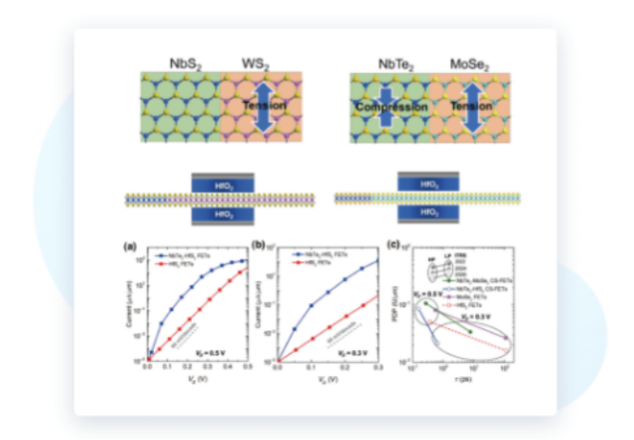
Using two-dimensional transition metal-disulfide compound (TMD) cold metals NbX2 and TaX2 (X = S, Se, Te) as injection sources to design cold source transistors can achieve good switching efficiency and on-state current, which is conducive to improving energy efficiency.
ref. Physical Review Applied, 13(6), 064037 (2020)
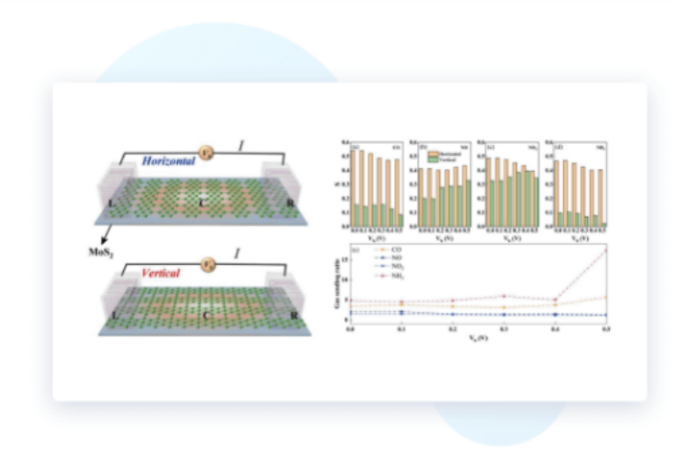
Gas sensors designed using atomically thick β12 boronene materials exhibit high gas-sensitive anisotropy, especially for NH3 molecules. By taking advantage of this highly anisotropic gas-sensitive ratio, the detection of specific gas molecules can be achieved, and it has strong fault tolerance for errors caused by equipment and environmental fluctuations.
ref. Journal of Materials Chemistry C, 9(3), 1069-1076 (2021)
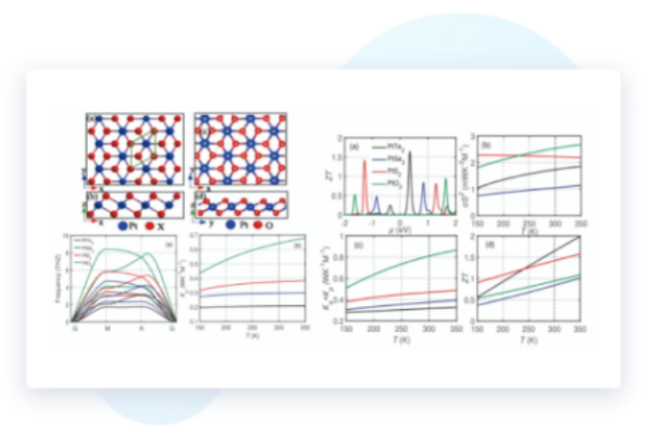
The conduction band of the single-layer PtX2 system shows almost degraded valleys, and there is a very flat curvature at the extreme values of the conduction band and valence band near the Fermi level, which leads to a large power factor. The lower lattice thermal conductivity also leads to the monolayer PtX2 having a large room-temperature thermoelectric merit value ZT.
ref. Applied Surface Science, 532, 147387 (2020)
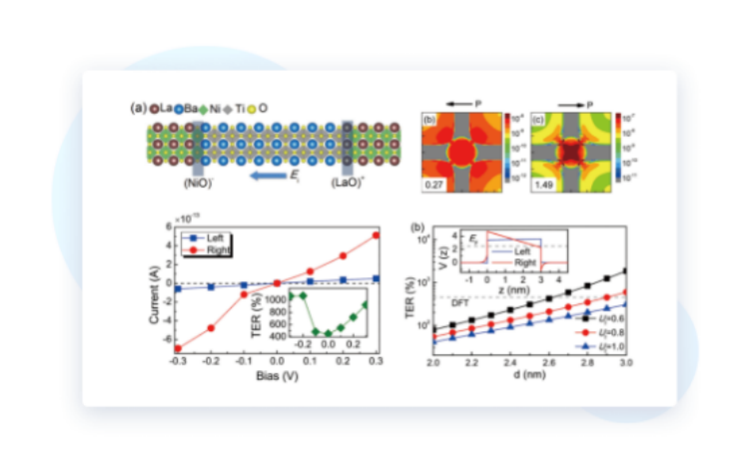
Based on the typical LaNiO3/BaTiO3/LaNiO3 ferroelectric tunnel junction (FTJ), a considerable tunneling electroresistance (TER) effect is achieved by constructing an asymmetric polar interface, and the physical origin of the TER effect is deeply understood from multiple levels, providing new insights for the design of FTJ-based devices.
ref. Applied Physics Letters, 108(6), 062903 (2016)
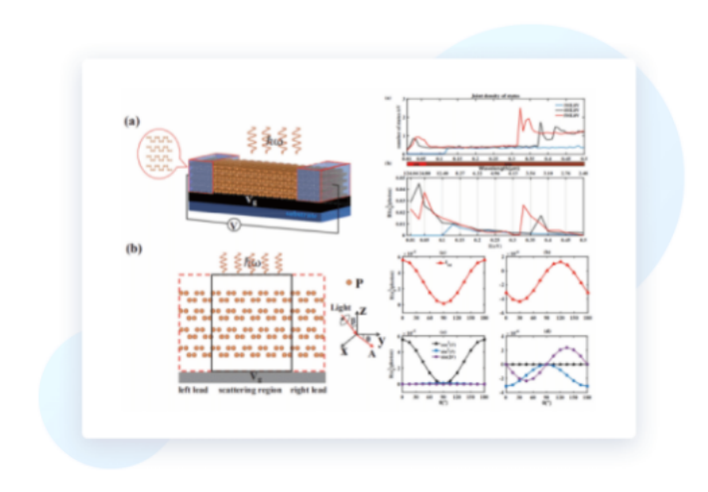
A broadband photodetector was designed based on pure few-layer black phosphorus. The gated few-layer black phosphor photodetector is self-powered and can greatly suppress dark current. In addition, the photodetector also features a high polarization sensitivity, an extinction ratio as high as 104, and a large anisotropic light response. This paves the way for the new application of few-layer black phosphorus in self-powered, controllable broadband photodetectors.
ref. Physical Chemistry Chemical Physics, 23(1), 399-404 (2021)
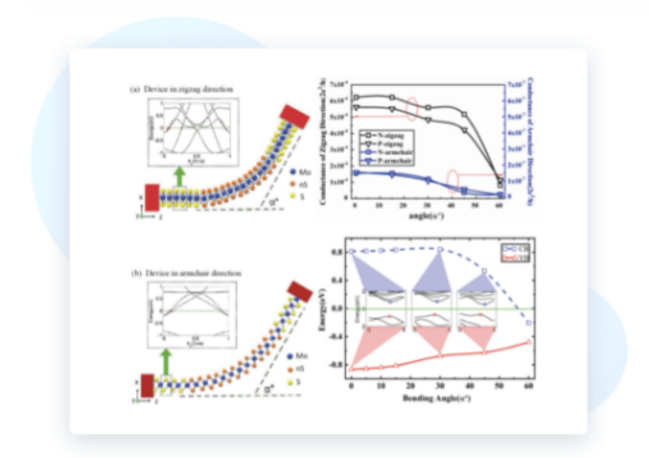
Flexible devices were designed based on two-dimensional 1T phase MoS2 materials, which were bent in the Z-shaped direction and the armchair direction respectively. Considering the influence of N-type or P-type doping, theoretical guidance and physical mechanisms were provided for achieving reliable flexible MoS2 transistor devices.
ref. Physical Chemistry Chemical Physics, 22(38), 21888-21892 (2020)
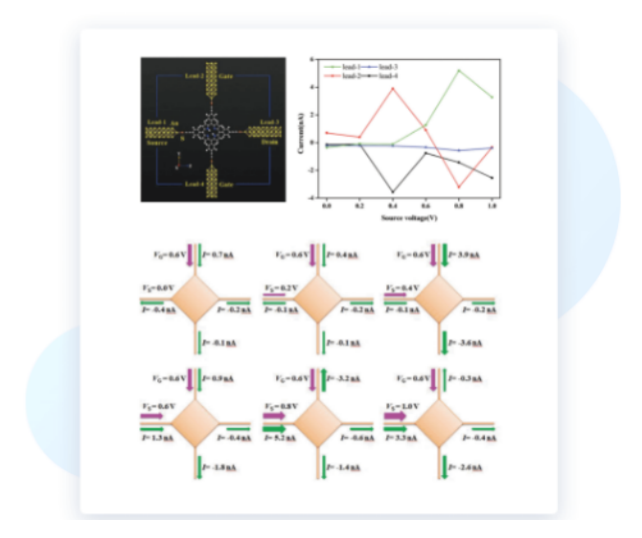
Porphyrin-phenylacetylene (PPA) molecules are connected to Au nanowires through S bonds to construct four-port devices. A distinct negative differential resistance (NDR) effect was observed in the device, and the relative magnitudes of the gate and source voltages could regulate the current directions of the gate and source. When the gate and source voltages were equal, input/output current switching could be achieved.
ref. New Journal of Chemistry, 45(5), 2520-2528 (2021)